
What is a Coupling? Shaft Coupling Elements – Properties and Applications
Couplings are essential mechanical connection elements that connect two separate shafts in machine and motor systems, enabling the safe transmission of rotational motion and torque. Used to ensure accurate and efficient power transmission in industrial machinery, couplings help systems operate more stably. At the same time, they compensate for shaft misalignment, extending the service life of machine components.
In machine systems, the power generated by a motor often needs to be transmitted to another mechanical component. Couplings ensure that this power transfer is performed safely and in a balanced manner. In shaft systems connected directly without couplings, vibration, wear, and misalignment errors can occur more rapidly. Couplings reduce these risks, contributing to more efficient and safer system operation.
Another important advantage is their ability to absorb vibration and shock. Especially flexible coupling types absorb vibrations generated during operation, improving machine performance and preventing damage to other mechanical components. They also protect the system during sudden load changes, preventing damage to more expensive equipment.
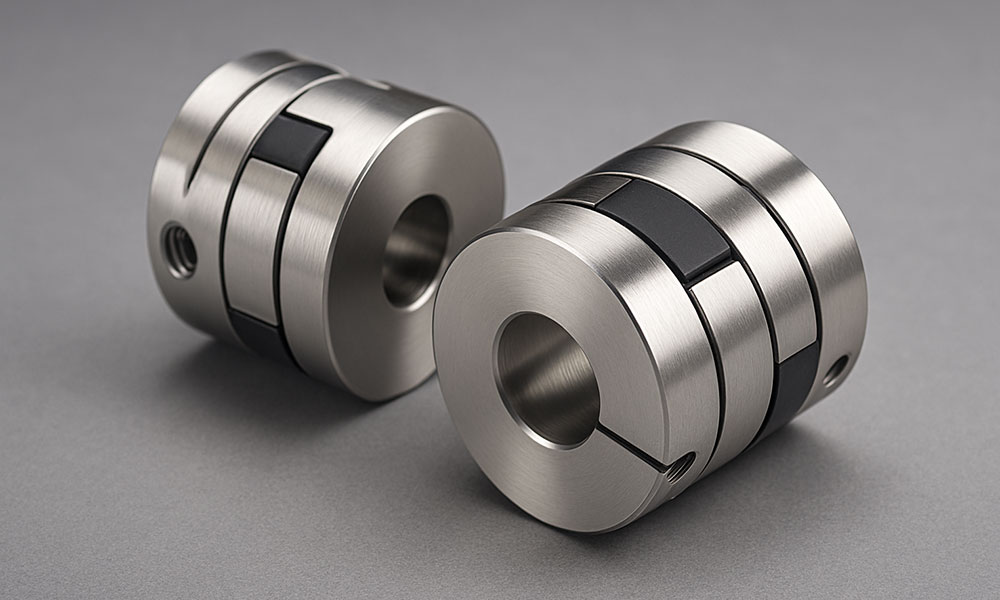
Couplings are manufactured in various types depending on application requirements. Rigid couplings are used in systems where shaft axes are perfectly aligned, while flexible couplings can tolerate minor misalignments. Elastomeric, grid, and flanged couplings are selected based on torque capacity and vibration damping requirements.
Technical Specifications
- Function: Ensures safe transmission of torque and rotational motion between two shafts
- Structure: Consists of a rigid or flexible body connecting the driving and driven shafts
- Material: Can be manufactured from alloy steel, stainless steel, cast materials, or elastomer components
- Alignment Compensation: Can tolerate angular, axial, and parallel shaft misalignments (especially flexible types)
- Vibration Damping: Reduces system vibrations for more stable operation
- System Protection: Protects equipment against overloads, shocks, and sudden torque variations
- Ease of Maintenance: Many coupling types allow easy installation and removal
- High Torque Capacity: Designed to handle high power transmission in industrial machinery
Applications
Couplings are used in many industrial systems for power transmission, including:
- Machine and motor systems: Electric motors, pumps, compressors, and conveyor systems
- CNC machines: Precision shaft connections and high-accuracy applications
- Automation systems: Power transmission components and torque transfer points
- Petrochemical and energy sector: Systems operating under high torque and heavy-duty conditions
- Fan and blower systems: Equipment requiring balanced rotational motion transmission
- Gearbox connections: Power transmission between motor and reducer
- Industrial production lines: Continuously operating machine systems
Coupling Types
- Rigid Couplings: Used in systems where shaft axes are perfectly aligned
- Flexible Couplings: Reduce vibration and tolerate minor misalignments
- Elastomeric (Jaw / Spider) Couplings: Provide shock and vibration damping through elastomer inserts
- Grid Couplings: Preferred for heavy-duty applications requiring high torque transmission
- Flanged Couplings: Provide strong and secure connections in large machines
- Universal Joint Couplings: Allow motion transmission in angular shaft connections
In conclusion, couplings are critical mechanical components that ensure safe, efficient, and balanced power transmission in machine systems. Selecting the correct coupling not only improves system performance but also significantly extends the service life of machinery.